

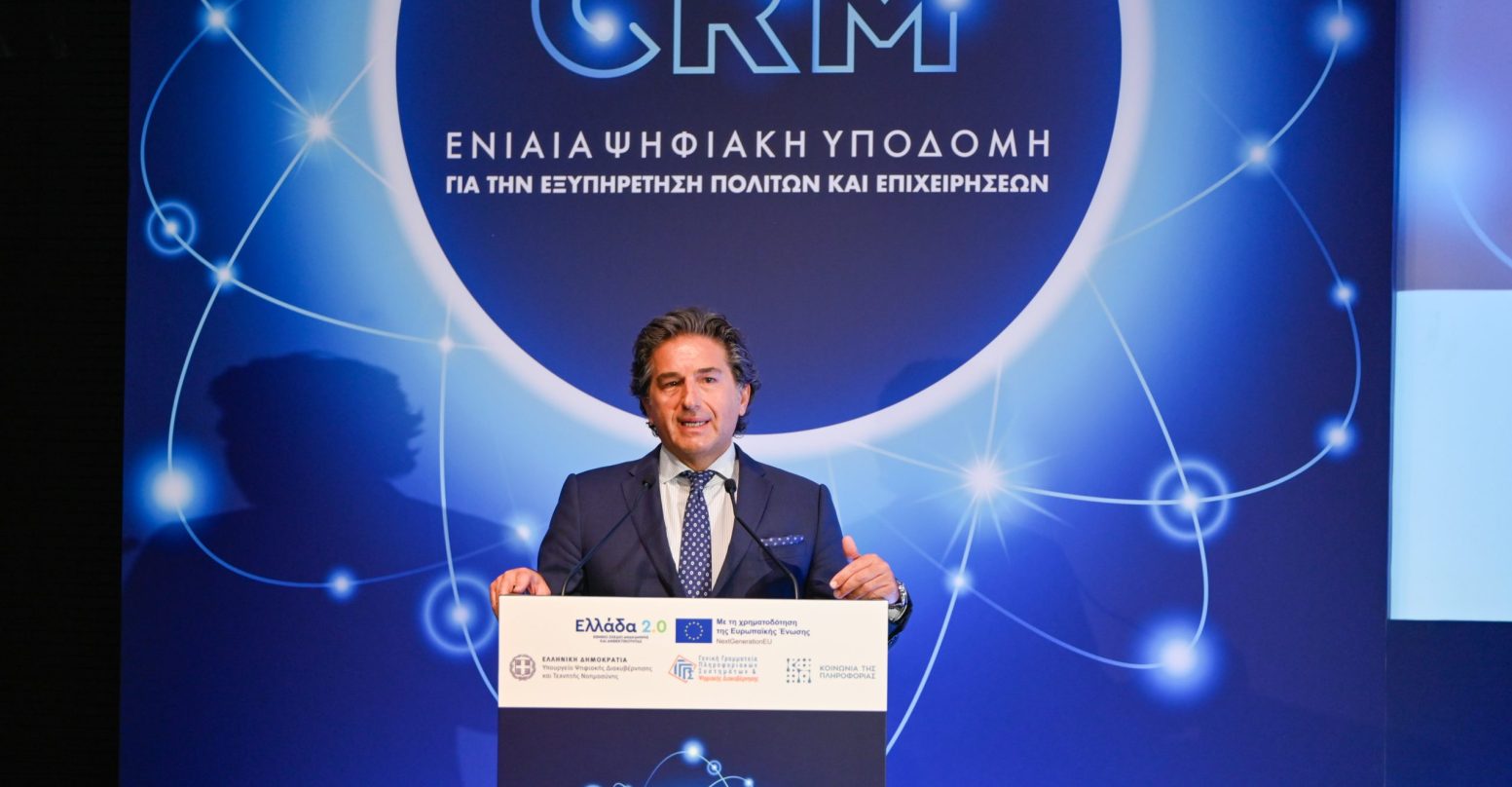
The transition from the digitisation of individual services to a unified, personalised model of serving citizens and businesses was highlighted during the “The Next Step for the Digital State: CRM as a pillar of a unified and personalised service experience”, held in Thessaloniki by the Secretariat-General for Information Systems and Digital Governance of the Ministry of Digital Governance and Artificial Intelligence and Information Society (Information Society Single-Member S.A.).
The conference was attended by representatives of the government, public administration, local authorities and the scientific community, who highlighted Unified CRM as a strategic reform that aspires to unify the points of contact between citizens and the Public Administration, offering faster, more transparent and personalised services.
The opening ceremony was held by Konstantinos Gkioulekas, Deputy Minister of Interior, responsible for issues concerning Macedonia-Thrace, who referred to the major change that has taken place in the way public administration operates. As noted, the country is definitively leaving behind time-consuming bureaucratic procedures, and Unified CRM is here to unify Public Services on a common platform, enhancing transparency, efficiency and service towards citizens. “The Ministry of Digital Governance and Information Society are proposing a system focused on our own facilitation”, he said, emphasising that “public administration is making the big leap”.
For his part, the General Director of Projects at Information Society, Dimitris Giantsis, emphasised that CRM is not yet an information system, but a shift in philosophy in the way the State treats its citizens. “We now want to project the image of the functioning of a unified state. Put an end to fragmentation”, he noted, explaining that the project connects the Citizen Service Centres, gov.gr, the call centre, artificial intelligence services and the management of citizen affairs in a unified environment.
Presenting the implementation of the project, he emphasised that the biggest challenge is not only the technological aspect, but also the cooperation of public bodies and the change in the culture underpinning public administration. As he mentioned, citizens will be able to be served through multiple channels, monitor the progress of their requests through gov.gr and receive personalised updates, with artificial intelligence supporting services where possible.
At the same time, Mr. Giantsis pointed out that citizens’ expectations regarding the digital state have changed definitively. “There is a public sector before and after gov.gr,” he said, emphasising that the next step is a more humane Public Sector, without eliminating in-person service for those who need it.
DiaNEOsis’ Research Director, Fay Makantasi, pointed out that, despite the historically low trust in state institutions, current digital public services, and especially gov.gr, show very high levels of satisfaction. She highlighted that digital illiteracy continues to be a factor of social exclusion and that citizens desire personalised services, without the loss of human contact or emerging concerns about the management of their personal data.
On the subject of trust, Mr. Giantsis noted that CRM is hosted in the country’s most contemporary data centre and has been designed following strict security and personal data protection standards. “The biggest bet is interoperability. The better the systems converse and exchange data securely, the better citizens will be served,” he concluded.
The Mayor of Ampelokipi – Menemeni, Lazaros Kyrizoglou, described CRM as a strategic intervention that changes the operating philosophy of the Public Sector. He emphasised that “the state must address digital illiteracy, so that no citizen is left out of this new digital reality”.
When the subject of the role of Local Authorities was broached, the Mayor of Larissa and chairman of the Digital Governance Committee of the Central Union of Municipalities of Greece (KEDE), Athanasios Mamakos, underlined that CRM places citizen at its centre, contributing to the reduction of bureaucracy. He emphasised, however, that the success of the project depends on a change in mindset, the continuous training of civil servants, technical support for smaller municipalities and the effective interoperability of both information systems, and the public services themselves.
The Regional Councillor for Central Macedonia, Anna Tzika, referred to the significant progress that has been made in recent years regarding the digital transformation of public administration, noting that the goal should be “equal service to all citizens, even in the most remote areas of the country”. She noted that “the transparency offered by digital tools enhances both the efficiency of services and the trust of citizens”.
Closing the workshop, the Director of the Prime Minister’s Office in Thessaloniki, Ioannis Papageorgiou, stressed that the digitalisation of the State is a solid national strategy and that Greece has made significant steps in recent years. Referring to the more than 2.7 billion digital transactions that have taken place, he added that the country is no longer at the tail end of European developments and that technology now facilitates citizens and public officials alike. “It’s not a matter of ‘will do’. We are in the midst of evolution”, he said, emphasising that the endgame remains the creation of a friendly state that respects citizens.
The workshop was coordinated by journalist Maria Samolada.
The project is implemented within the framework of the National Recovery and Resilience Plan “Greece 2.0” with the funding of the European Union – NextGenerationEU. Information Society Single-Member S.A. is the central planning, development and implementation hub of the Ministry of Digital Governance for implementing ICT projects in the Public Sector and plays a major role in implementing Greece’s national Digital Transformation.





