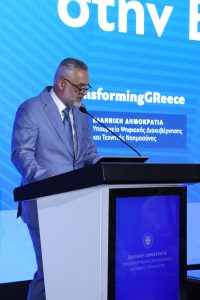


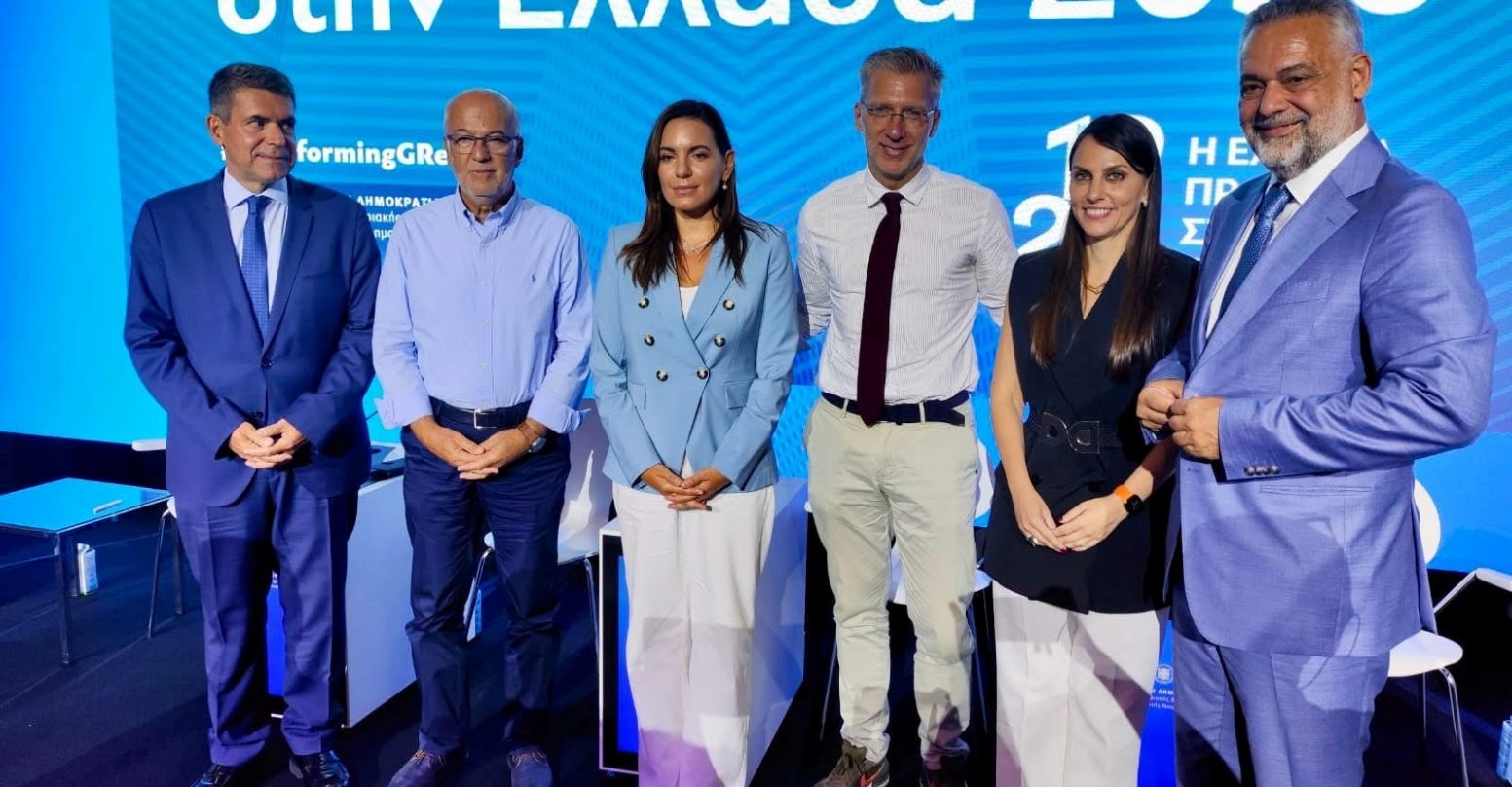
Information Society S.M.S.A. presented the outcomes of the digital transformation and the priorities for Greece 2030 at the 90th Thessaloniki International Fair
Minister of Justice Giorgos Floridis shared his conviction that the Greek justice system will be on a par with the best in the world within the next two years, speaking at the Information Society S.M.S.A. event “#TransformingGreece: From Greece 2.0 to Greece 2030”, which took place on Saturday, 5 September, at Pavilion 12, as part of the 90th Thessaloniki International Fair.
The event highlighted the outcomes of the largest national digital transformation effort implemented through the National Recovery and Resilience Plan “Greece 2.0”, as well as the challenges of the coming period for a more modern, effective, and human-centric State.
Information Society S.M.S.A. highlighted its contribution as a central hub for the planning, development and implementation of major digital projects in critical areas of public life.
The event was attended by the Minister of State, Akis Skertsos; the Minister of Justice, Giorgos Floridis; the Minister of Tourism, Olga Kefalogianni; and the Deputy Minister of the Interior, Vivi Charalambogianni.
The Secretary-General for Information Systems and Digital Governance, Dimosthenis Anagnostopoulos, also delivered a brief welcome address.
The opening address was delivered by Stavros Asthenidis, Chief Executive Officer to Information Society S.M.S.A.
Before the speeches began, a video was screened showcasing Information Society S.M.S.A.’s project implementation review for the 2019-2026 period.
The event was hosted and moderated by journalist Giannis Tzanopoulos.
Giorgos Floridis: The Greek justice system is entering a new era
The Minister of Justice underlined that the digital systems developed create the conditions for a radical upgrade of the judicial system. He highlighted in particular the digital electronic file, e-drafting and e-filing of lawsuits, alongside the Judicial Map reform and the unification of the first-instance courts.
As he noted, at the Athens Court of First Instance, where approximately 60% of the country’s cases are heard, the time taken to set a court date has been reduced from four or four and a half years to seven to eight months. At the same time, the issuance of a copy of a criminal record, which previously took one or two months, can now be completed within five minutes.
Giorgos Floridis also highlighted the imminent deployment of Artificial Intelligence to transcribe court minutes, ensuring they can be distributed within two hours, while enhancing the organization and processing of legal case law. Finally, he emphasized that the next crucial step is to train judges, lawyers and court staff on the new systems.
“Once the deployed systems operate at even 50% of their potential, Greek justice will definitively enter a new era”, he noted, while acknowledging the role of Information Society S.M.S.A. in this major upgrade.
Akis Skertsos: The digital foundations have been laid for the public sector’s great leap forward
The Minister of State, Akis Skertsos, emphasized that the digital foundations have now been laid for the Greek public sector’s next major leap forward, so that the State can become even more people-centric and focused on the needs of its citizens.
He stressed that digitalization serves to combat deep-seated challenges, such as clientelism and the unequal application of the law, thereby reinforcing equality, the rule of law, and impartiality in citizen-state interactions. He also emphasized the importance of public service measurement and evaluation by citizens themselves as a tool for designing better policies.
The Minister of State noted that Greece, having ranked 26th in the European DESI index in 2019, has now surpassed the European average in areas such as the digitization of public health and digital services for citizens and businesses.
Olga Kefalogianni: Digital tools for sustainable and competitive tourism
The Minister for Tourism, Olga Kefalogianni, highlighted the importance of utilizing data to shape modern tourism policy. She referred to the National Observatory for Sustainable Tourism Development, the regional observatories and the completion of the digital transformation of the Greek National Tourism Organization (EOT).
She made special mention of the excellent cooperation between the Ministry of Tourism and Information Society S.M.S.A. in implementing the “Tourism for All” program while also mentioning the mAiGreece app, which serves as a personalized digital assistant for visitors, providing information before, during and after their trip, as well as guidance in the event of extreme weather conditions.
She noted that Greece is now in a position to showcase internationally the significant strides it has achieved in digital transformation.
Vivi Charalambogianni: The goal is a state that will not request supporting documents from the citizens
The Deputy Minister of the Interior, Vivi Charalambogianni, emphasized that tracking and measuring administrative workflows now enable the civil services to pinpoint unnecessary steps and implement substantial simplifications.
Highlighting a recent analysis of 20 administrative workflows representing 8.5 million transactions, she noted that simplifying these processes could generate €100 million in savings and eliminate 3.3 million in-person visits to public administration offices. She stressed that the main objective is to create a State that does not require citizens to submit supporting documents that are already available to the Administration.
Stavros Asthenidis: Transitioning from project delivery to the ongoing stewardship of digital public value
Opening the event, Stavros Asthenidis, Chief Executive Officer to Information Society S.M.S.A., emphasized that the country’s digital leap forward is not measured solely in terms of platforms and electronic transactions, but primarily in the time saved for citizens, the administrative burden lifted from businesses, the transparency that is enhanced, and the trust that is built between the State and society.
“The most difficult challenge we were called upon to tackle was to carry out hundreds of projects and initiatives simultaneously, across different sectors of public life, within strict timeframes and with high technical and operational requirements, without compromising either the strategic direction or the quality of the outcome”, he said.
Stavros Asthenidis outlined the range of initiatives being implemented in Health, Justice, Public Administration, Telecommunications, Entrepreneurship, Tourism, Shipping, Agriculture, Diplomacy, Culture, Education and Civil Protection. In the area of Justice, projects currently underway include the upgrade of IT and telecommunications infrastructure, the digitization of archives, electronic case management, and the installation of teleconferencing systems in courts and prisons.
Looking ahead, he emphasized that the country is moving away from the development phase and entering the phase of operation, maintenance, upgrade, and continuous optimization of digital services:
“We are transitioning from the era of delivering projects to the era of ongoing stewardship of digital public value. If the previous period was the era of digitization, the next must become the era of the intelligent operation of the State”
The Chief Executive Officer of Information Society S.M.S.A. emphasized that Artificial Intelligence takes on real public value when applied to well-designed processes, backed by reliable data, and accompanied by transparency, accountability, personal data protection, and robust cybersecurity guarantees.
In closing, he dynamically set the tone for the next period:
“The modern intelligent State must solve the problem, not simply digitalize it and return it to us with a new password”.
The event confirmed that the completion of the major cycle of projects funded by the Recovery Fund does not mark the conclusion of the digital transformation journey, but rather the starting point of a new and more demanding period.
Information Society S.M.S.A. continues to transform national priorities into operational projects, and these projects into measurable results for citizens, businesses, and the public administration.