

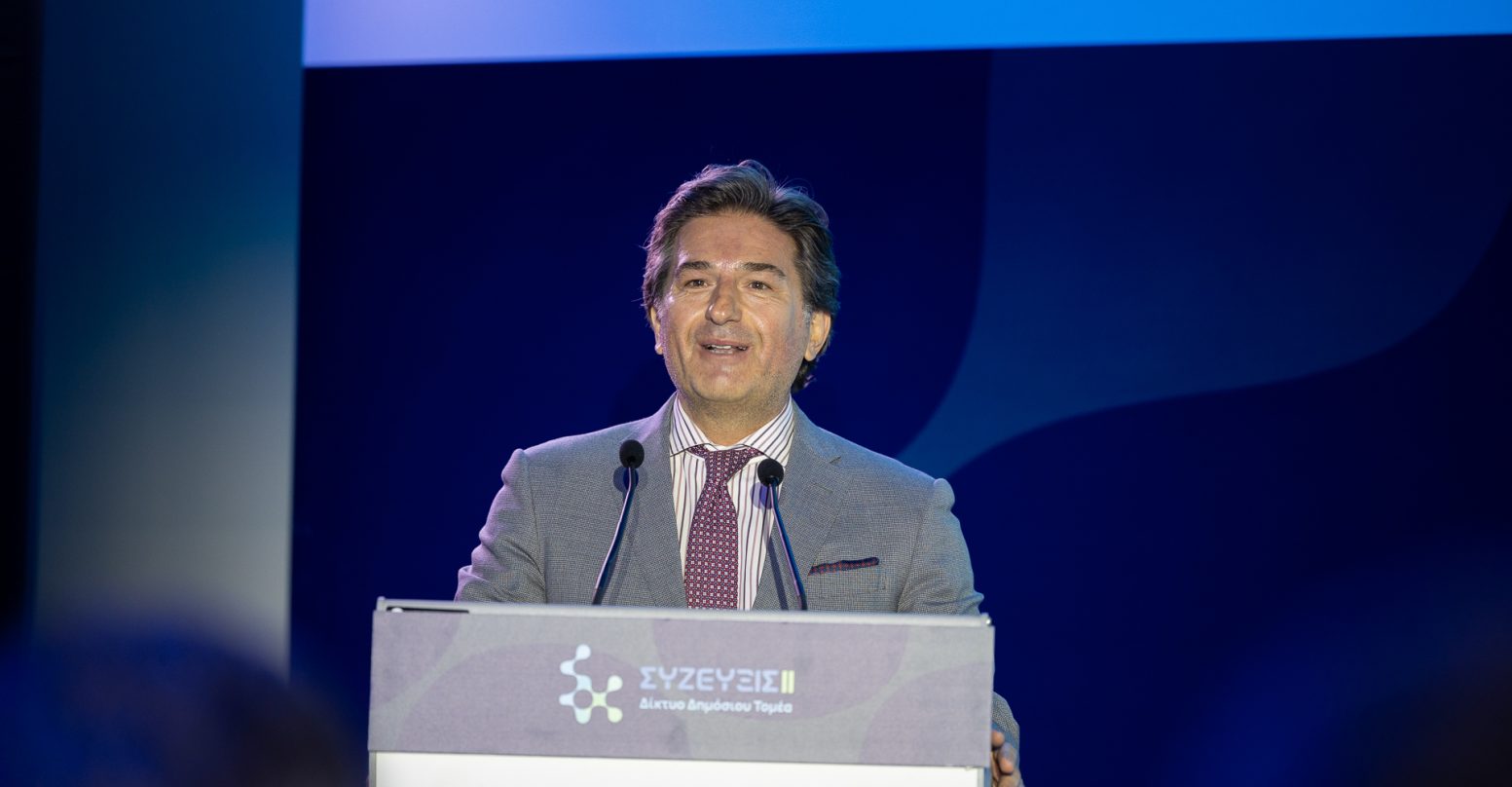
SYZEFXIS II, the nationwide project that forms a key pillar of the new digital architecture of the Public Administration, was the focus of the conference entitled “SYZEFXIS II as a Key Pillar of the New Digital Architecture of Public Administration”, where government officials, representatives of institutional bodies, the business sector, healthcare, cybersecurity and the academic community highlighted the strategic importance of the project for the country’s digital transformation.
The joint conclusion of the conference was that SYZEFXIS II is not merely a major technological infrastructure project, but a critical piece of national infrastructure upon which the functioning of the modern digital state relies.
In his opening remarks, the Secretary-General for Information Systems and Digital Governance at the Ministry of Digital Governance, Demosthenes Anagnostopoulos, described SYZEFXIS II as a critical piece of infrastructure for the functioning of the state, noting that without it, modern electronic transactions between citizens and the state would not be possible. As highlighted, the transition from a model where citizens had to carry files and documents from one government department to another, to today’s digital services via gov.gr and the interoperability between agencies, is based precisely on this interconnectivity. He also emphasised that “the project is evolving to meet contemporary technological requirements, with speed upgrades and a focus on cyber security and training”, describing SYZEFXIS as “the backbone of the public sector”.
For his part,Dimitris Giantsis, General Director of Projects at Information Society Single-Member S.A., noted that this is a complex and demanding project, which has evolved within a rapidly changing technological environment that brings about constant changes to specifications, requirements and timetables. As he stated, “the project is currently around 70% implemented, with the aim of soon exceeding 80%, whilst the intention is to complete it by June 2027”. He emphasised that SYZEFXIS II is a project comprising dozens of individual contracts and requiring complex coordination between contractors, ministries and agencies, describing it as “hard, much afflicted but extremely useful” for serving citizens, civil servants and professionals. He also mentioned that the next generation of the project, SYZEFXIS III, is already being planned and is expected to follow after 2028.
Thanasis Avgerinos, Deputy Regional Governor of Eastern Attica, stressed the importance of digital infrastructure for citizens’ daily lives, with the aim of reducing inconvenience and facilitating access to public services.
During the presentation of the project, Charis Stellakis, Head of the Infrastructure Project Management Department at Information Society Single-Member S.A., outlined the scale and technical architecture of SYZEFXIS II, which covers approximately 34,000 organisations of the Greek public sector, with upgraded broadband infrastructure, voice, data and video services, 55,000 mobile phone and smartphone connections, 45,000 data connections, 72 million SMS messages, data centre services, ISP, telecollaboration, DNS, web hosting and advanced cybersecurity infrastructure. He also highlighted the project’s economic impact, through reduced telecommunications costs, economies of scale and better use of public and EU funds.
In the section on the Public Sector Network as a catalyst for digital initiatives, Giannis Foustanakis, Secretary-General for Public Administration at the Ministry of the Interior, described the project as “a much-expected and crucial development for the public sector, with direct benefits for citizens through greater transparency and efficiency”. He also emphasised the importance of human resources training, noting that around 30,000 hours of training have already been implemented.
Mr Gantsis cited video hearings, remote witness examination, and telemedicine in remote areas as examples of the direct implementation of SYZEFXIS II, emphasising that all these applications require robust and secure connectivity.
The Chair of SEPE, Giota Paparidou, described SYZEFXIS II as one of the country’s most important infrastructure projects and a pioneering initiative even at a European level, emphasising that cooperation between the public and private sectors is crucial to its successful completion. The economies of scale and the benefits that a unified network brings to the running of the state were also highlighted.
In the section on health,Vasilis Kontozamanis, former Deputy Minister of Health, highlighted the importance of interoperability and the utilisation of data for better decision-making within the healthcare sector, noting that projects such as the electronic patient files require robust interoperability infrastructure. Michalis Cheimonas, Director General of the Hellenic Association of Pharmaceutical Companies (SFEE), underlined the need for closer cooperation between the public and private sectors in the pharmaceutical sector, whilst Michail Michalopoulos, Head of the General Directorate of Digital Infrastructure at IDIKA Single-Member S.A., emphasised high speeds, data security and the preservation of the human touch in healthcare.
In the section on data economy, the Deputy Minister of Justice, Ioannis Bougas, highlighted the role of digital transformation in speeding up the administration of justice, with an emphasis on transparency, security and efficiency. He referred to the digital reforms that reduce red tape and significantly reduce the time needed to resolve cases. Vasiliki Pantelopoulou, Secretary-General of the NSRF, highlighted the project’s contribution to the country’s transition into a new digital era, with the primary aim of ensuring equal access for all citizens to the new services, whilst the President of the Economic Chamber, Konstantinos Kollias, emphasised the importance of digitalisation for regional development and the reduction of inequality.
In the section on cyber security, the Deputy Director of the National Cybersecurity Authority, Dr. Giannis Pavlosoglou described cyber resilience as a marathon, with the aim of ensuring business continuity even under conditions of cyberattack. Triantafyllos Karatrantos, Research Fellow at the Hellenic Foundation for European and Foreign Policy (ELIAMEP), highlighted the need for a European strategy for cooperation in the face of new threats, noting that artificial intelligence can act both as a challenge and as a tool for strengthening cyber defence.
In the final section on education, the Deputy Minister of Education, Nikolaos Papaioannou, emphasised that the digital transition is already changing the role of teachers and the educational process, “with artificial intelligence acting as a tool to support, rather than replace, the human element”. The Rector of the National Technical University of Athens, Ioannis Chatzigeorgiou, noted that robust digital networks are a crucial prerequisite for research, teaching and the extroverted nature of universities, whilst Katerina Pramatari, a founding member of the Uni.Fund and Professor at the Athens University of Economics and Business, highlighted the need for students to have immediate access to modern digital tools and infrastructure.